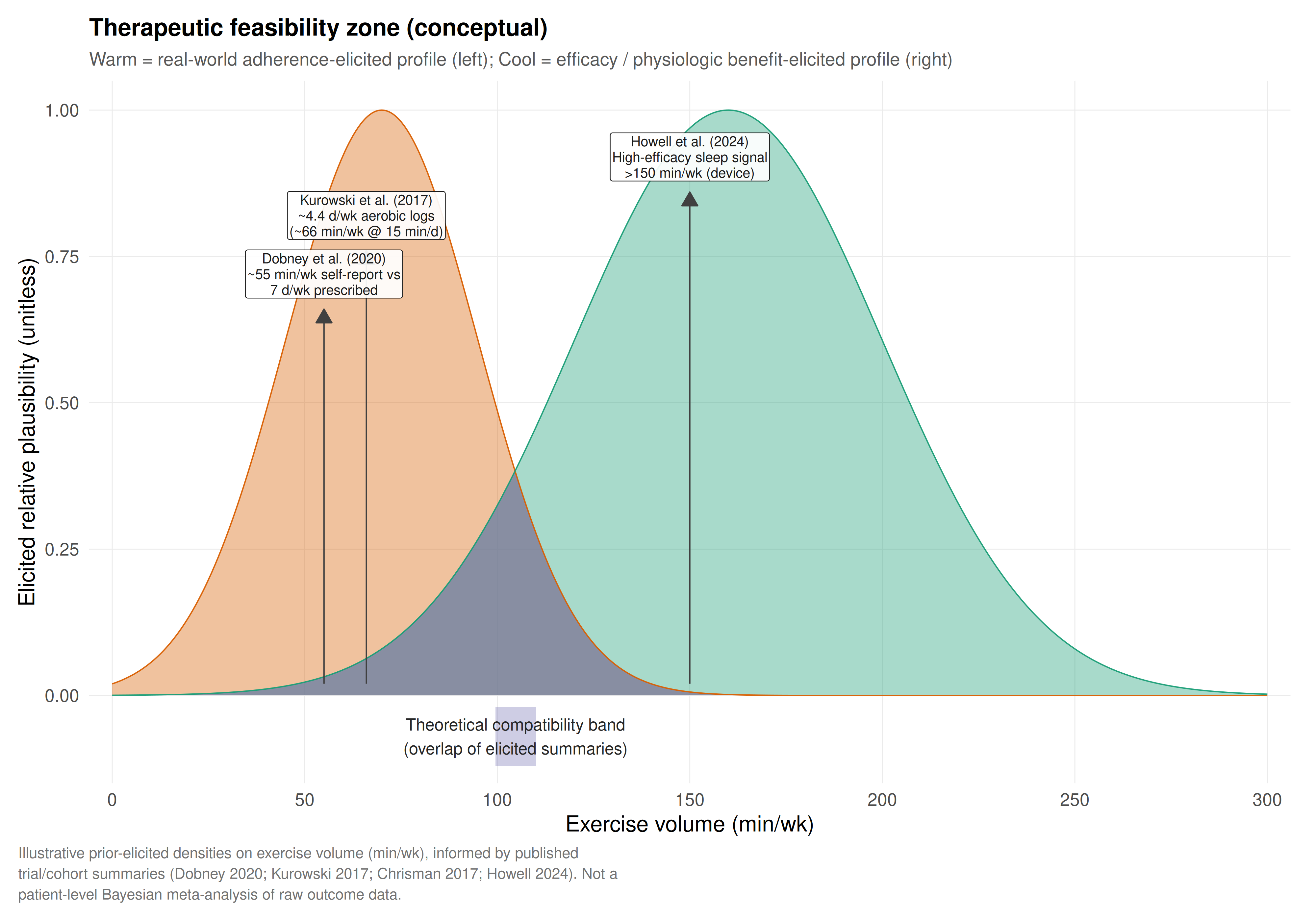
Therapeutic feasibility zone (conceptual)
A three-panel conceptual figure on the adherence-efficacy gap, cross-study dosing heterogeneity, and net clinical benefit
One of the clearest patterns emerging from the PPCS aerobic exercise literature is the gap between how much exercise is prescribed and how much patients actually complete—and what that gap means for interpreting efficacy data.
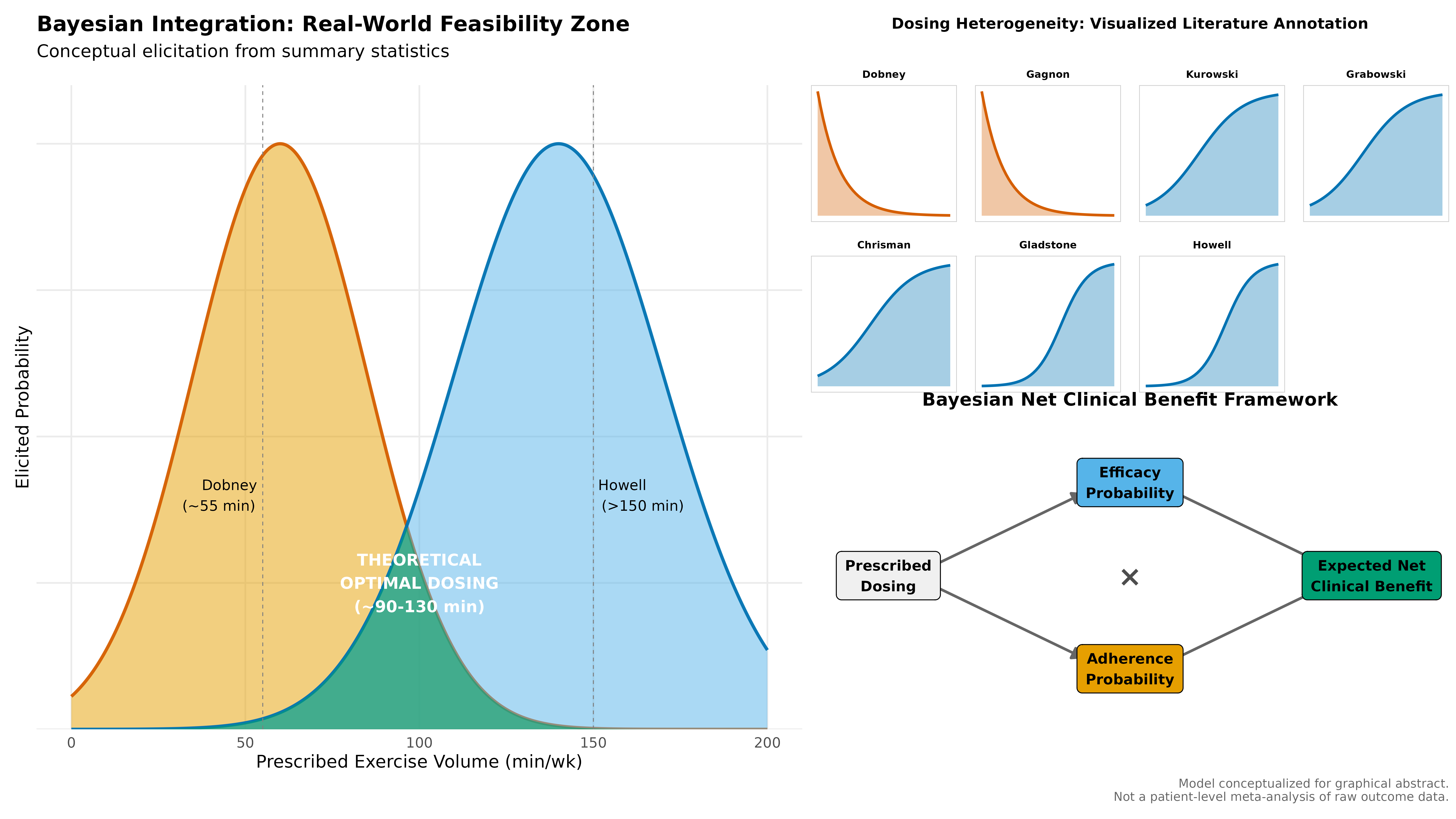
This figure tries to make that gap visible. The left panel elicits plausibility curves for weekly exercise volume from four published studies, showing that real-world adherence clusters around 55–75 min/wk, while physiological benefit signals appear above 150 min/wk. The middle panel maps dosing distributions across seven studies to illustrate why pooling them in a standard meta-analysis would be misleading. The right panel frames the underlying logic as a DAG: net clinical benefit depends not just on what is prescribed, but on whether patients actually reach therapeutic dose.
All curves are prior-elicited from published summary statistics—not fit to raw patient data. This is a conceptual illustration, not a Bayesian meta-analysis.
PDF (vector): Quantitative_Framework_Dashboard.pdf � Earlier single-panel version: Therapeutic_Feasibility_Zone.png � Script: Meta_Analysis/scripts/04_therapeutic_feasibility_zone.R (PPCS SR repo).